- When: February 1st through February 28/29th.
- Purpose: To commemorate the impact of Black Americans on arts, music, science, and politics, while confronting systemic injustice and fostering education beyond mainstream narratives.
- Origins: Created by Carter G. Woodson (known as the "Father of Black History") and the Association for the Study of African American Life and History (ASALH) to ensure Black history was included in education.
- Why February: It was chosen to align with the birthdays of Frederick Douglass and Abraham Lincoln.
- Significance: It serves as a reminder to honor the, often overlooked, contributions of Black individuals throughout the year, not just in February.
Pages
Tuesday, March 10, 2026
Black History is American History: Reclaiming Our Narrative
Monday, September 15, 2025
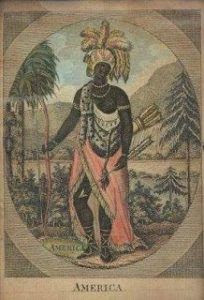
Black American Aborigines Enslaved Prior to Trans-Atlantic Trade of Enslaved Africans.
| An Emblem of America. Description: An allegorical figure of America as a woman in Classical dress standing beside a plinth inscribed to the memory of George Washington. A native American child with feathered headdress also stands beside the stone. In the background is Niagara Falls with native American figures. Decorative elements include American flag, spear, and tree. Record number: 86-23. |
. Beginning with European colonization in the late 15th century, the trade grew into a major economic and political force that had a devastating impact on Indigenous communities. While some Native tribes practiced forms of captive-taking before contact, the arrival of Europeans dramatically altered the scale and nature of Indigenous slavery.
- Purpose: Captives were often used to replace deceased tribal members, assimilate into the community, or serve as diplomatic pawns rather than as an economic labor force.
- Status: The status of "slave" was often not a permanent, inheritable status. Captives and their children could eventually be integrated into the tribe.
- Scale: Pre-European slavery was not practiced on the massive, commercial scale that the colonizing powers later established.
- Spanish colonization: European enslavement began with Christopher Columbus, who captured and sent TaĆno people back to Spain on his first voyage. The Spanish later created the encomienda system, which forced Indigenous labor in mines and on plantations, leading to the rapid decimation of Indigenous populations in the Caribbean.
- English colonies: The English became heavily involved in the Indigenous slave trade to fill the need for labor in their colonies and the Caribbean. South Carolina was the largest exporter of enslaved Native Americans, selling between 30,000 and 51,000 captives between 1670 and 1715. In fact, in the late 17th century, South Carolina exported more Native Americans than it imported enslaved Africans.
- Native American involvement: European powers exploited and exacerbated rivalries between Native tribes, providing guns and goods in exchange for enslaved captives. This created a destructive cycle of inter-tribal warfare where groups raided others to gain power and acquire goods.
- High mortality: Enslaved Native Americans had high death rates from disease and brutal conditions.
- Risk of escape: Colonists found that Indigenous people, who were enslaved on or near their homelands, could easily escape and seek refuge with other tribes. This led colonists to export captives to the West Indies, New England, or other colonies far from their homes.
- Conflicts: The trade incited devastating wars among Native tribes, destabilizing the region and threatening colonial expansion. The Yamasee War of 1715, spurred partly by trader abuses, was a key factor in the trade's end in the Carolinas.
- African slavery: A shift toward using enslaved Africans as the primary labor force occurred as they were seen as a more stable and cost-effective investment.
- Westward continuation: Spanish, Mexican, and American colonists continued enslaving Native Americans in the Southwest and West well into the 19th century.
- Legal justifications: In places like New Mexico and Utah, legal codes were designed to enable the practice under euphemisms like "servitude" or "apprenticeship," even after slavery was abolished nationally.
- Mixed heritage: Enslaved Indigenous women and African men often intermarried, and their mixed-heritage children were often designated as "colored" in records, which helped obscure the history of Indigenous enslavement.
- Five Civilized Tribes: In a tragic irony, the Cherokee, Choctaw, Chickasaw, Creek, and Seminole nations adopted the practice of owning African slaves as part of their strategy to assimilate into white culture and hold onto their lands.
- It contributed to the massive population decline of Indigenous peoples through violence, disease, and displacement.
- It disrupted and destroyed traditional Indigenous kinship networks and societies.
- The widespread practice of selling Indigenous people overseas led to their erasure from many regional histories.
- The legacy of the trade continues to affect Indigenous communities, with modern descendants working to reclaim their heritage and dignity.
| Love & Peace Candles now Available @ Purpoz Healing Arts Shop https://www.etsy.com/shop/PurpozHealingArts?ref=dashboard-header |
Friday, March 21, 2025
Creek Indian Locality - Southeastern Woodland Indians (locality #2)
The Muskogee is commonly known as Creek. According to earlier travels from the northeast to the south east little is known about the origins of the word “Muskogee”. The Creek “villages” were located on prime locations with fertile farmland, all southern rivers and creek (Terrell, 1971), (Swanton, JR, 1952).
References
Swanton, JR. “The Indian Tribes of North America. Bureau of American Ethnology Bulletin, 145: 1-726.
Terrell, John Upton. “American Indian almanac.” Barnes & Noble, Inc. 1971.
Monday, March 3, 2025
Southeastern Woodland Indians #1: Cherokee Locality
The Cherokees lived on the highest region of the southeast. The vastly forested Appalachian ranges that peak in the southwest Virginia, western north, and South Carolina, eastern Tennessee, northern, Georgia, and northeastern Alabama. They were a large tribe. The names of nearly 200 Cherokee towns Have been preserved, and although not all of them have been precisely located. It has been learned that they spread over vast area, it is speculated to be more than 40,000 mi.² (Terrell, 1971).
Reference
Terrell, John Upton. “ American Indian almanac.” Barnes & Noble, Inc. 1971.
Friday, July 8, 2022
Session 1: Going Within: Ancestral Guidance
Saturday, February 12, 2022
What's the difference between Native Americans and American Aborigines?
| Love & Peace Candles now Available @ Purpoz Healing Arts Shop https://www.etsy.com/shop/PurpozHealingArts?ref=dashboard-header |
Sunday, February 7, 2021
10 Amazing Facts About the Copper Colored Indians of North America
Hi, Family. I did this video based on the book called 103 Facts About the Black Indians. For this particular video, I only discussed 10 amazing historic facts about the Copper Colored Indians of North America. Please like, comment, and share this video. - Love & Peace!
Sunday, August 23, 2020
The Origins of American Aboriginal Shamanism & Munay-Ki
Hi family, I just uploaded a video on the origins of shamanism. In this lecture, I go over the spiritual practices of the indigenous American Aborigines. I also discussed Munay-Ki, an ancient energy healing practice found in Brazil. Go to the link in the bio or the link below @ http://youtu.be/-kptgbh0m44. Please Share, Love & Peace.
Thursday, August 20, 2020
We Were Already Here
![]() |
Cleon & Abell Taylor (Cherokee & Creek Indian (Georgia) 1940's) |
Check out my YouTube video about my grandmother @ http://www.youtube.com/watch?v=FVwDYedR75k
Wednesday, August 19, 2020
Creek Indian Nation and Black Wall Street (Bosley, Oklahoma)
![]() |
| Creek Indian Nation and Black Wall Street (Bosley, Oklahoma) |
Creek Indian Nation and Black Wall Street. This is a photo of black wall street in Bosley , Oklahoma. On my channel (Kimberly Purpoz) I research and educate the masses on various historical topics about the American Aborigines. Check out the Kimberly Purpoz channel @ http://www.youtube.com/user/purpoz1. Please share my video - Love & Peace.
#AmericanAboringines #blackwallstreet #americanaboriginal #americanaboriginalindian #negroindians #coppercoloredindians #africanamerican
Tuesday, August 18, 2020
False Narratives of American Aboriginals & Rona Data
Monday, August 17, 2020
American Indians and Chakras (Indigenous Insight)
Some of us are lacking indigenous insight because we are too fixated and focused on the physical plane. What we see with our eyes, we perceive as being the complete reality/truth. More of us need to look from within and tap into the inner universe of the most high. I gave a lecture about the American Indians' ways of balancing your chakras and tapping into indigenous insight in my video @ http://www.you.com/watch?v=EajT86KTMtU&t=26s.
Donate @:
Check out my YouTube channels:
Kimberly Purpoz, Purpoz TV, Psychology Essence, and more @ https//www.youtube.com/user/purpoz1.
Please share my videos. Love & peace!! #americanaboriginalindian
#americanaborigine
#AmericanAboringines #chakras #chakrahealing